Species is the first real decision in a custom kitchen, and it drives both the look and a meaningful share of the price. Here's how the five we build with most actually behave.
Quick comparison
| Species | Hardness (Janka) | Grain | Best finish | Relative cost |
|---|---|---|---|---|
| Hickory | 1,820 — hardest | Bold, high contrast | Natural or light stain | $$ |
| Hard maple | 1,450 | Very fine, subtle | Paint, or light stain | $$ |
| Red / white oak | 1,220–1,360 | Strong, open grain | Stain | $$ |
| Cherry | 950 | Smooth, fine | Clear or light stain | $$$ |
| Knotty alder | 590 — softest | Even, with knots | Stain | $ |
Janka hardness measures resistance to denting. Higher is harder. For cabinet doors it matters less than it does for flooring — nobody drops a cast-iron pan on a cabinet door — but it's a fair proxy for how a surface holds up over decades.
Hickory — the most durable, and the loudest
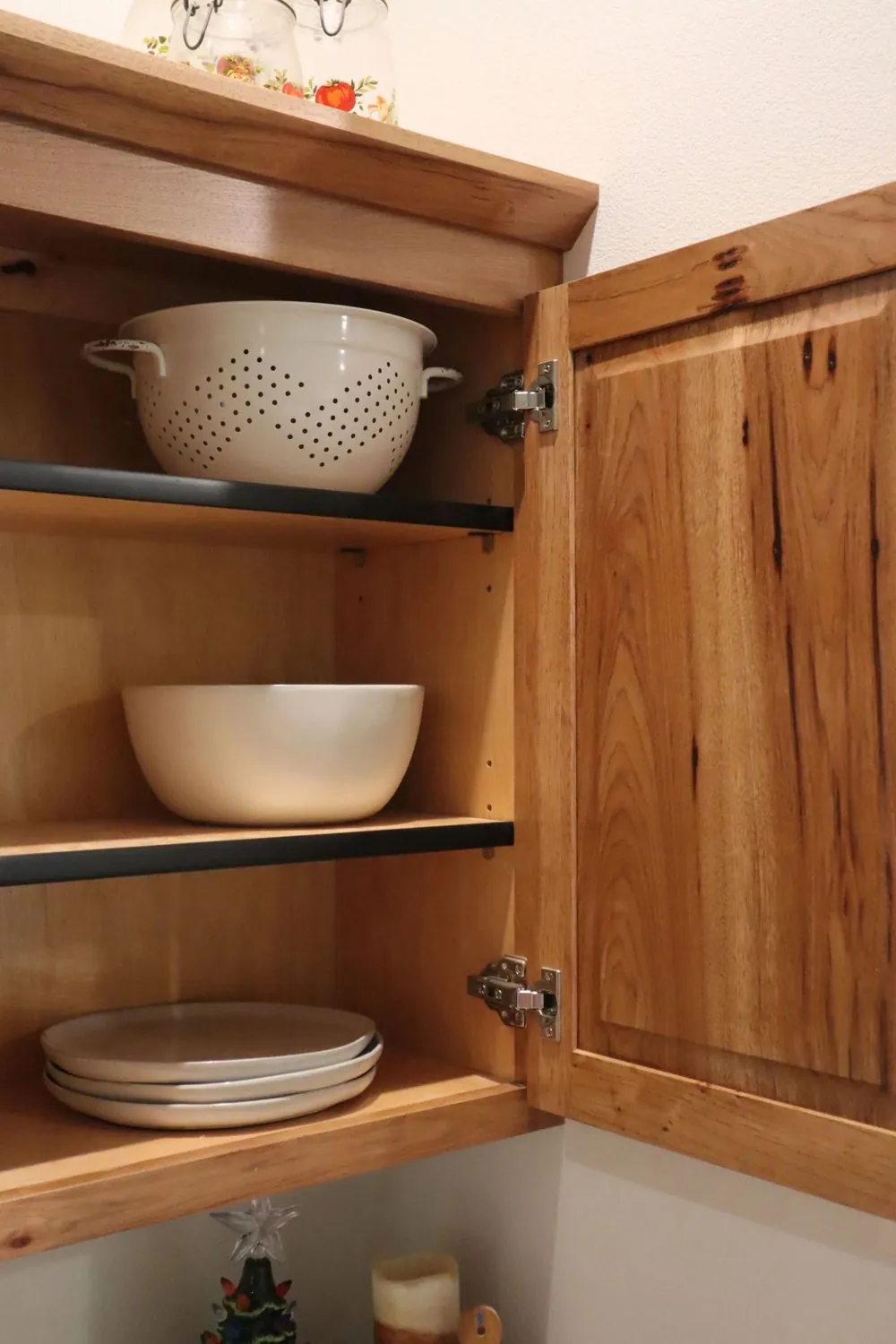
Hickory is the hardest domestic hardwood in common cabinet use, and it has the widest color variation of any of them. A single door can run from near-white sapwood to deep reddish brown. Left natural, no two doors in your kitchen will look alike.
That's either exactly what you want or exactly what you don't. Hickory is the signature of a rustic or farmhouse kitchen and it does not read as subtle. It's also genuinely tough, which is why it shows up in farm kitchens and lake places that take real use.
Choose hickory if: you want visible character, a rustic or farmhouse look, and maximum durability.
Skip it if: you want a calm, uniform kitchen, or you're planning to paint — painting hickory wastes what you paid for.
Hard maple — the one to paint
Hard maple is dense and tight-grained with very little visible figure. Under a clear finish it's pale, clean and modern. Under paint it's close to ideal: the grain doesn't telegraph through, so a painted maple door reads as a smooth, solid color rather than a wood door wearing paint.
Nearly every painted kitchen we build is hard maple, including the sage green kitchen in our gallery. It takes stain acceptably but can blotch under dark stains, so if you want dark and stained, oak or alder is a safer path.
Choose maple if: you want painted cabinets, or a light contemporary look with minimal grain.
Skip it if: you want dramatic visible grain, or a rich dark stain.
Oak — the traditional workhorse
Oak has an open, strongly-figured grain and takes stain more predictably than almost anything else. Red oak leans warm and pink; white oak is cooler, browner and denser, and quarter-sawn white oak — cut to expose the ray fleck — is the premium version and priced accordingly.
Oak spent the nineties as the default builder cabinet and got unfairly tarred by it. The oak of that era was orange-toned and glossy; that was a finish choice, not the wood's fault. In a modern flat or matte finish, white oak in particular looks entirely current.
Choose oak if: you want visible grain with a traditional feel, or you want a specific stain color to land predictably.
Skip it if: you want a smooth grain-free surface, or the open grain reads dated to you.
Cherry — the one that changes
Cherry is the most refined of the five: fine, smooth grain, a warm reddish tone, and a surface that finishes beautifully. It's also the one with a behavior you need to know about before you commit.
Cherry darkens with light exposure. Substantially, over the first six to twelve months. That's normal and most people consider it the whole appeal, but it means a sample looks lighter than your kitchen will in a year — and anything left sitting on a cherry surface for months can leave a lighter patch underneath.
It's also softer than maple or hickory and dents more readily. And it costs more.
Choose cherry if: you want a formal, warm, traditional kitchen and you like the idea of the wood aging.
Skip it if: you want the color to stay exactly as delivered, or you need maximum dent resistance.
Knotty alder — the value option that doesn't look cheap
Alder is the softest of the five and the most affordable, and it earns its place for a specific reason: it takes stain exceptionally evenly. Knotty alder gives you visible rustic character from the knots without hickory's aggressive color swing, which makes it the most controllable way to get a warm rustic kitchen.
Being soft, it dents more easily than hickory or maple. In a rustic kitchen that's largely irrelevant — the look absorbs wear rather than fighting it, which is a real advantage in a busy house.
Choose alder if: you want a warm stained rustic kitchen and you want the budget to go further.
Skip it if: you want maximum dent resistance or a formal, knot-free surface.
So which should you pick?
- Painting? Hard maple. It isn't close.
- Rustic and hard-wearing? Hickory.
- Rustic, warm and budget-conscious? Knotty alder.
- Traditional with a specific stain color in mind? Oak.
- Formal and warm, and you like patina? Cherry.
One practical note that matters more than any of the above: look at a finished sample of your actual species in your actual kitchen, in daylight and at night, before you commit. Wood looks entirely different under a showroom's lights than under yours. We bring samples to the consultation and make a finished sample on your chosen species before we run the whole kitchen.
Want a real number for your kitchen?
The in-home consultation is free, and you'll get a firm written quote with the wood, finish and hardware spelled out.