
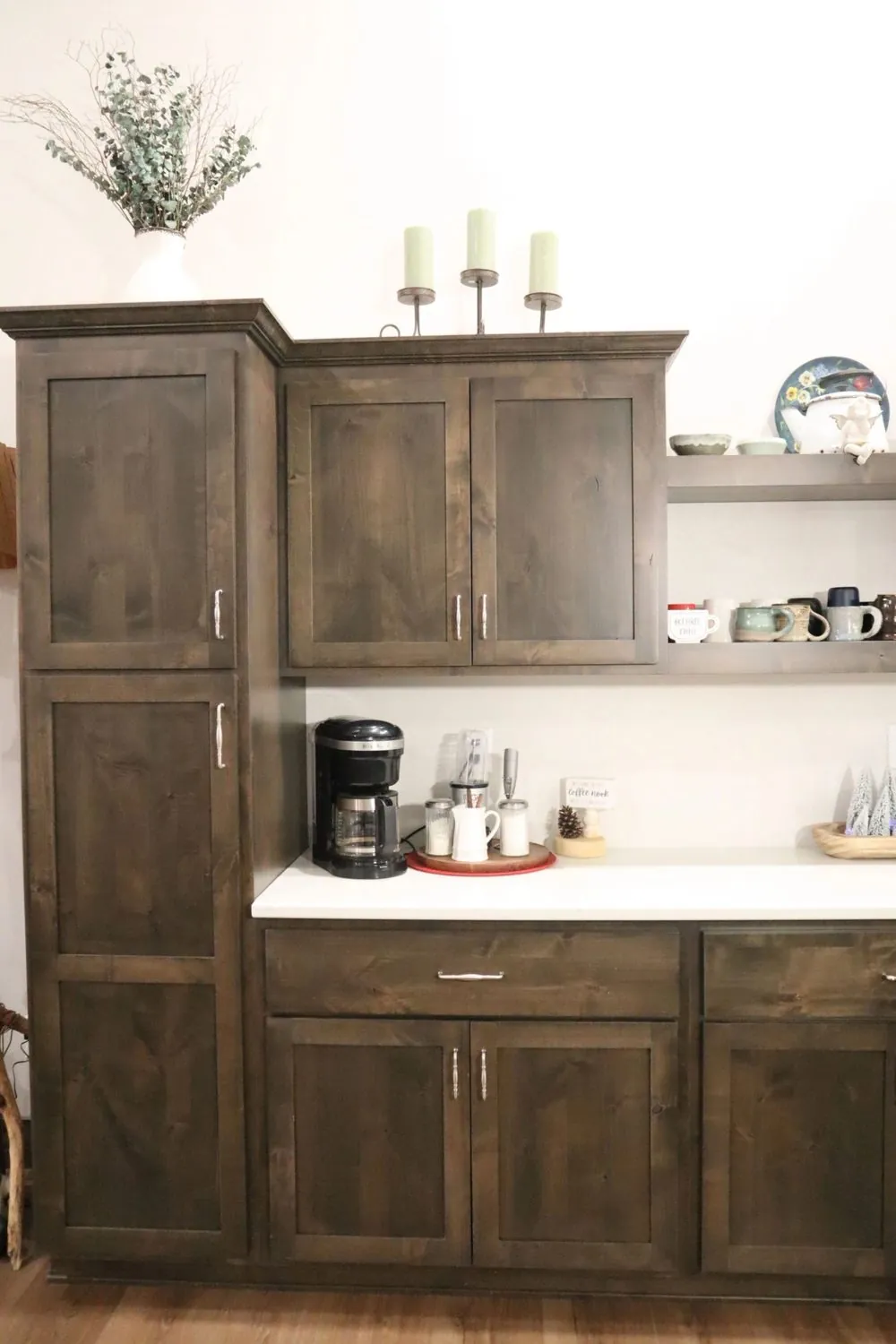
This is the first question almost everyone asks, and most cabinet shops won't answer it until you've sat through a consultation. That's a sales tactic, not a limitation. Here are the numbers.
The short answer
In our shop, in western and central Wisconsin, most full custom kitchens land between $18,000 and $35,000 for cabinetry, hardware, finish, delivery and installation. Smaller kitchens and single-room projects generally start around $9,000. Whole-home projects — kitchen plus baths, mudroom and office — run $40,000 and up.
Those are honest working numbers, not teaser pricing. Nationally, Amish cabinetry is often quoted in a $15,000–$50,000 band with fully custom work reaching much higher, and rural Wisconsin shops tend to sit at the more reasonable end of that range.
Why cabinets are quoted per linear foot
The industry prices cabinetry by the linear foot — the total run of cabinetry measured along the wall, counted separately for upper and lower runs. It's a useful shorthand because it scales with the actual size of your kitchen instead of a vague notion of "big" or "small."
As a rough national framework:
- Stock cabinets — roughly $150–$400 per linear foot. Pre-made sizes, limited species, particleboard boxes.
- Semi-custom — roughly $400–$800 per linear foot. Stock sizes with real choices in door style and finish.
- Fully custom — roughly $800–$1,500+ per linear foot. Built to your dimensions, any species, any finish.
A typical mid-sized kitchen has 25 to 30 linear feet of cabinetry, which is how a full custom kitchen arrives in the twenty-to-thirty-thousand range.
One caution: a per-foot number is only comparable if it includes the same things. Ask every shop you talk to whether their figure includes the finish, the hardware, the delivery and the installation. Ours does.
What actually moves the price
Wood species
This is the biggest single lever. Oak, maple and hickory sit at the affordable end. Cherry runs higher. Walnut and quarter-sawn white oak can add many thousands to the same kitchen with nothing else changed. If your budget is tight, changing species is the most effective adjustment available — and it changes the look far less than people expect once the finish is on.
Door style and overlay
A slab or shaker door in a standard overlay is the value baseline. Inset cabinetry — where the door sits flush inside the face frame rather than on top of it — typically adds 10–25%, because the tolerances are tighter and every door has to be fitted individually. It's beautiful, and it's genuinely more work.
Finish
Natural and stained finishes cost less than paint. Paint requires more surface prep, more coats and more careful handling, and it shows every flaw underneath, which is why painted kitchens are usually built from tight-grained species like hard maple. Glazes and distressing add labor on top of that.
Interior fittings
Roll-out trays, spice pull-outs, tray dividers, appliance garages, trash pull-outs, lazy susans and drawer organizers are each modest on their own and meaningful in aggregate. This is the easiest place for a quote to creep, so it's worth deciding early which ones you'll genuinely use.
Layout complexity
Corners are expensive. So are ceiling-height stacked uppers, integrated appliance panels, curved or angled runs, and islands with finished furniture-grade panels on all four sides. None of these are wasteful — they're just labor.
Where the money is best spent
After a lot of kitchens, a pattern holds. The things people are still glad they paid for years later:
- Drawers instead of doors on base cabinets. The single biggest day-to-day usability upgrade in a kitchen. You stop kneeling on the floor to find a pot.
- Cabinetry to the ceiling. Storage you'd otherwise lose, and it makes the room read as finished instead of stopped.
- A properly sized island. Not the largest one that fits — the one that leaves real walkways.
- Solid-wood construction. Which is the whole argument for a shop like ours, and the reason these kitchens are still fine in year twenty.
And the things people more often regret paying extra for: heavy distressing and glazing that dates quickly, elaborate crown stacks, and specialty pull-outs bought for a use case that never materialized.
What our quote includes
Cabinetry, all hardware, the finish, delivery and installation. Countertops, appliances, plumbing, electrical and flooring come from your other trades — we coordinate with them but don't mark their work up.
The quote is a firm number, not an estimate. It changes only if you change what's being built.
How to compare quotes fairly
If you're getting more than one number — and you should — make each shop answer these:
- Are the boxes plywood or particleboard?
- Are the drawer boxes solid wood and dovetailed, or stapled?
- Is soft-close hardware included or an upgrade?
- Does the price include the finish, delivery and installation?
- Who installs it — your crew, or a subcontractor?
- What's the lead time, and what happens if it slips?
Two quotes that look ten thousand dollars apart are frequently quoting two different products. These six questions usually explain the gap.
Want a real number for your kitchen?
The in-home consultation is free, and you'll get a firm written quote with the wood, finish and hardware spelled out.